SKIP TO CONTENT

info@nenasf.org
508-754-2671

Free MCTA Luncheon Update

Date: December 11, 2025
Category: Chapter News, Events, NASF Chapters, Regulation

Register Today
Free MCTA Luncheon Update

2025 in the Rear-View Mirror: 2026 Preview

Meet the New State Official Charged with Helping You with Regulatory & Permitting Issues

Agenda

  1. Legislative and State Regulatory Updates
    Update on significant legislative and regulatory issues from 2025 as we enter the second part of the legislative session.

  2. Introduction to the State’s new Regulatory Ombudsman Doug Gutro
    Have an issue related to a permit or regulatory issue? The new state Ombudsman is here to help! Doug Gutro was recently appointed to help companies get things done! He has extensive experience in government and is newly appointed to this position which is under the Secretary of Economic Development. Come hear how he may be able to assist you and your company.

  3. Member feedback and MCTA plans for 2026.

    To register, contact Katherine Robertson at katherine@masscta.org. A link will be sent to you.

2025 New England Surface Finishing Regional – Salem, Massachusetts

Date: November 19, 2025
Category: Chapter News, Events, Member News, NASF Chapters, NASF National, Regulation

NE Surface Finishing Regional Logo


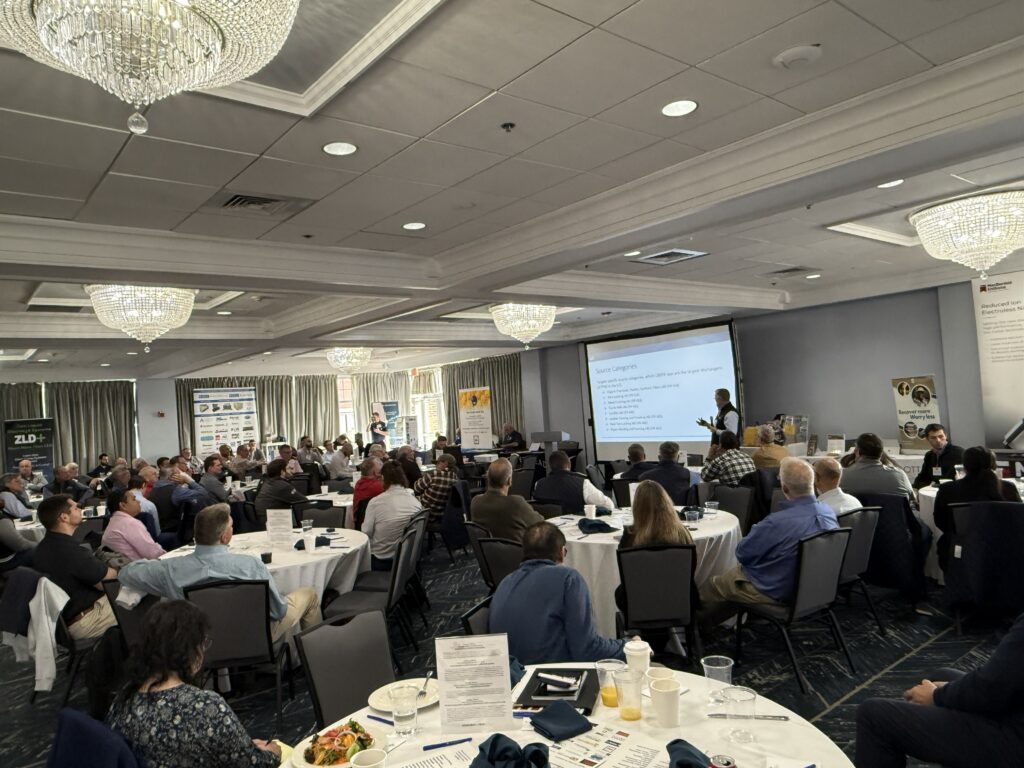
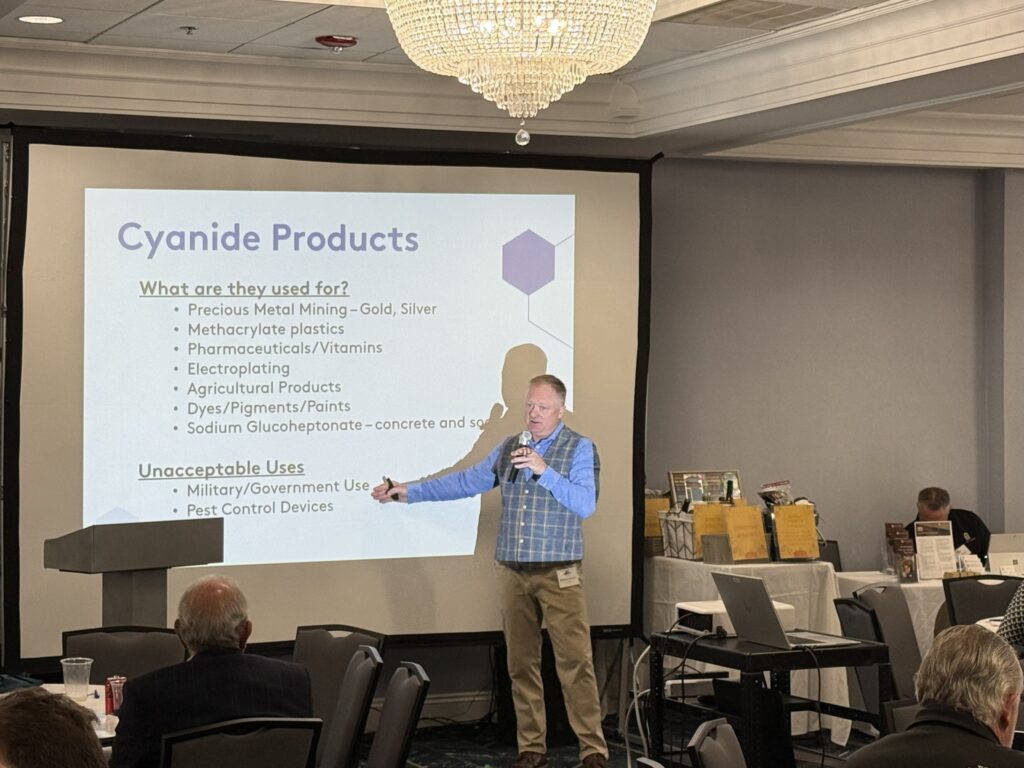
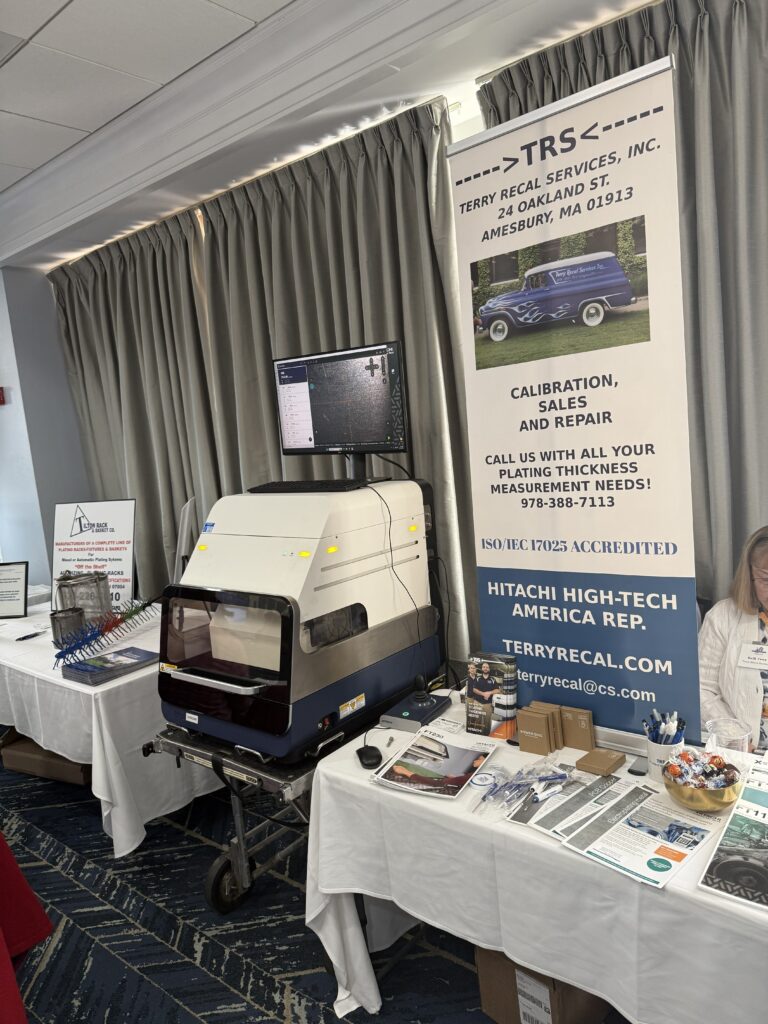
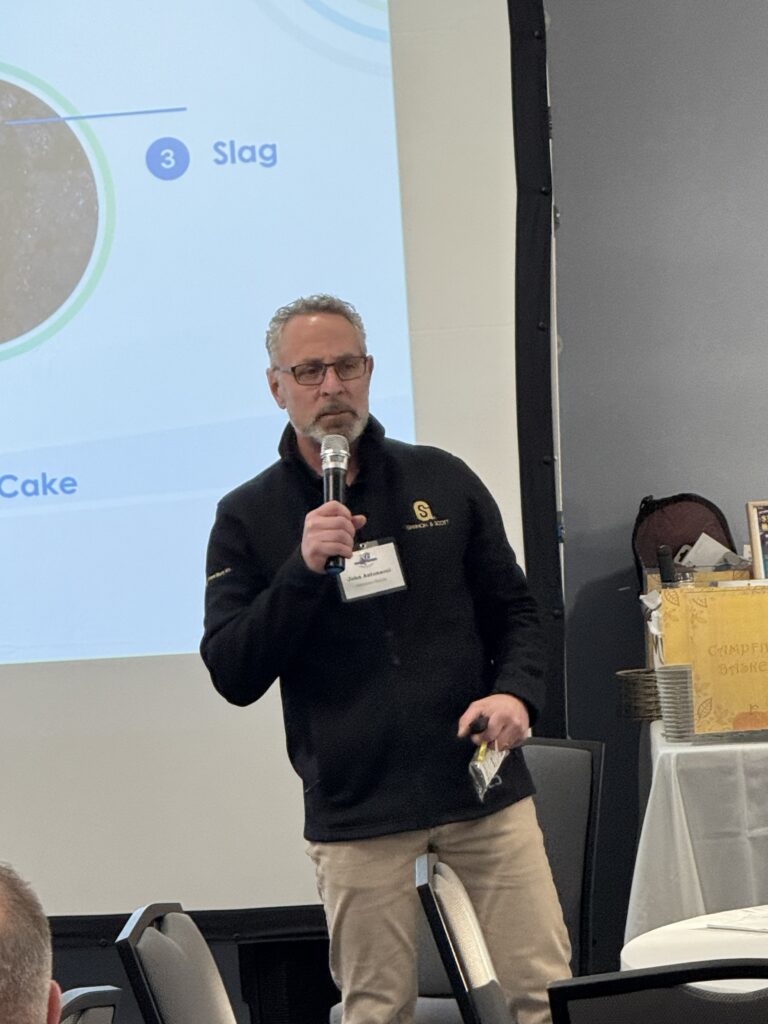
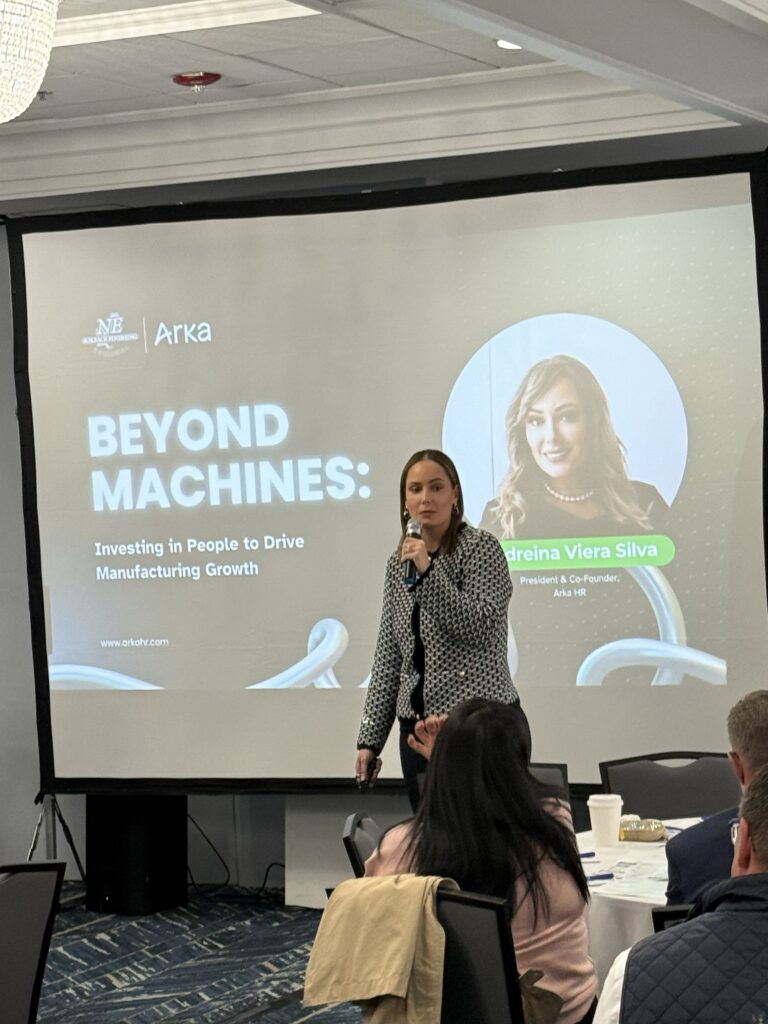
The New England Surface Finishing Regional took place this past Friday November 7th in Salem, Massachusetts. It was a huge success with a 125 people in attendance. There were speakers from all over the country that delivered educational and thoughtful presentations to all in attendance.

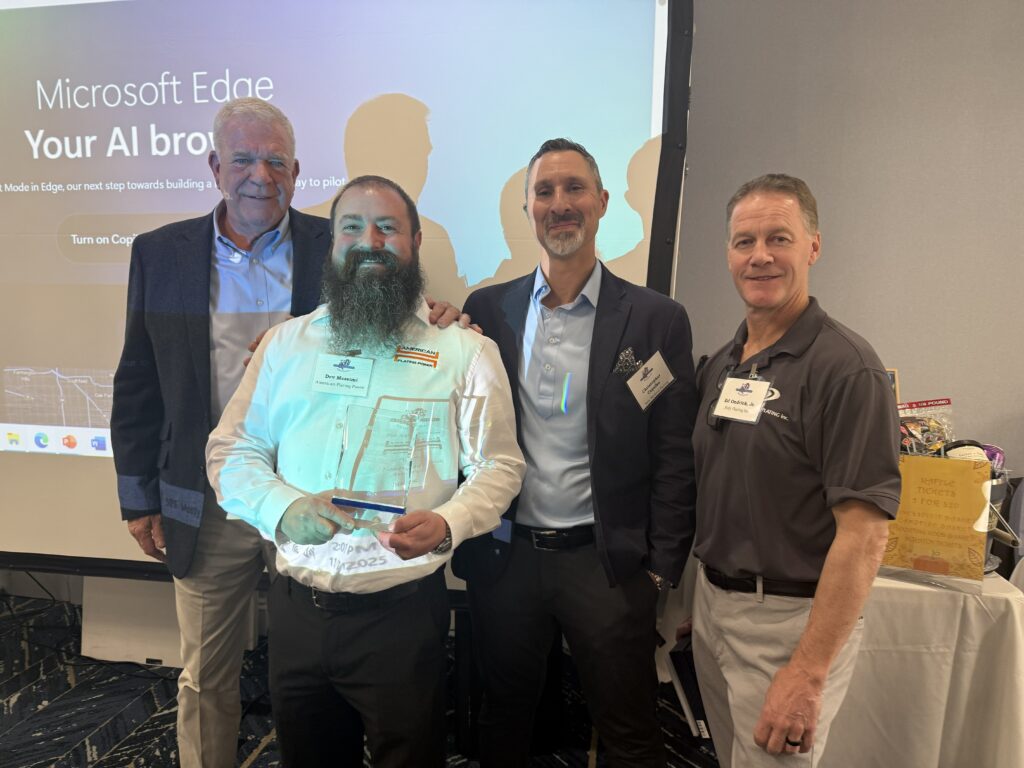
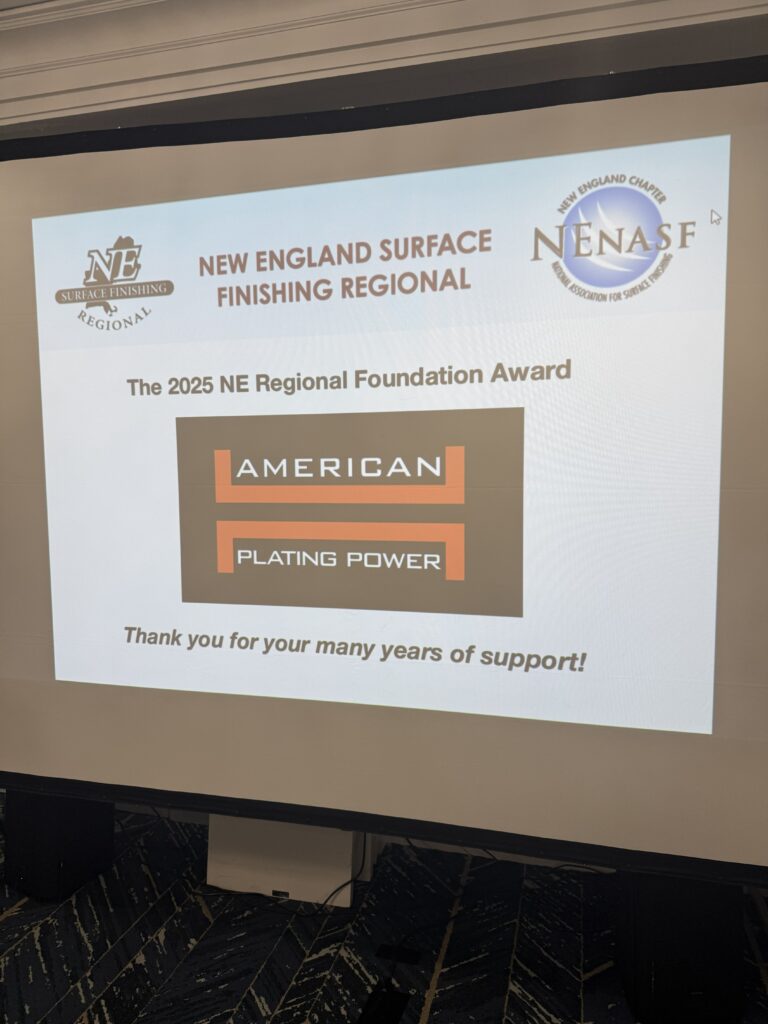
The New England Surface Finishing Regional is honored to have presented the 9th Annual Foundation Award to longtime supporter American Plating Power. The award was created to recognize a metal finishing supplier that has demonstrated outstanding contributions, support, and dedication to the annual regional event.

The 2026 the New England Surface Finishing Regional will be held November 6th in Newport, Rhode Island.

Please continue to follow www.nenasf.org all year for news and events throughout the New England metal finishing industry.
NENASF FALL WEBINAR SEPTEMBER 2025

Date: September 19, 2025
Category: Chapter News, Events, NASF Chapters, Regulation

New England Chapter of NASF Logo

The New England Chapter once again was pleased to offer a Wastewater Continuing Education Webinar for the benefit of our membership, and open to  the entire metal finishing community. The event took place on Wednesday September 17, 2025 from 10:00am to 12:00pm. This educational webinar was offered at no charge to NENASF members as a benefit of Chapter membership.

Almost forty attendees from the metal finishing community were in attendance.


As was the custom, the program was comprised of three speakers offering vital technical and regulatory compliance information key to the metal finishing community. All attendees were eligible for two Wastewater Continuing Education Contact Hours awarded by the Mass DEP.


Brock Helton, the Preventive Maintenance Manager from Crossair, LLC gave the opening presentation. His focus was on the latest exhaust fan and fume scrubber technologies with an emphasis on proper preventive maintenance to keep these units running properly to achieve peak compliance results.

This was followed with a presentation by John Tracy, VP of Global Business Development from Aclarity, who offered a presentation on the current very fluid regulatory climate on PFAS wastewater discharge regulations. John  offered a unique remediation solution to PFAS removal in waste water through the use of electrochemical destruction.

The final speaker was Brittany McKinney from PAVCO who addressed the attendees on the benefits of various Trivalent Chrome Plating options as a replacement for traditional Hexavalent Chrome Plating processes that are currently in the cross hairs of regulatory agencies throughout the country.


The NENASF Chapter wants to once again thank our presenters for their time and expertise offered in an effort to enhance the knowledge and awareness of the metal finishing community. Also, many thanks to the dedicated NENASF members who work so hard to make educational events like this possible.

Public Policy Report – May 2025

Date: May 31, 2025
Category: Events, NASF National, Regulation


See You at SUR/FIN! NASF Government and Industry Affairs Presentation on Thursday, June 5 @ 9:00 – 10:00 AM


It has been a historic year in 2025 on the public policy front with the many changes underway in Washington and beyond. With new faces at the agencies, historic changes underway across the federal government and new challenges emerging on metals and minerals, regulation, tariffs, defense and manufacturing competitiveness, there has been much on the agenda.


To keep members informed and hear your questions and concerns, we’ll look forward to seeing you and presenting the NASF Public Policy Update on Thursday, June 6 @ 9:00 – 10:00 am CT on the show floor stage.


We will be covering a number of topics and providing updates on major issues that impact the industry. We’ll also be available to answer questions all week as well.


In the meantime, see some of the latest developments this month below.


See you in Rosemont!


Federal Nickel Toxics and Exposure Profile Removed for Further Agency Review


The Agency for Toxic Substances and Disease Registry (ATSDR) has temporarily removed its recently finalized Nickel Toxicological Profile and related nickel documents from its public webpage. The agency, which operates under the Centers for Disease Control, states that it is now evaluating earlier health calculations associated with its final publication for nickel several months ago.


The ATSDR’s final Nickel Toxicology Profile, which it developed over several years and published in November 2024, raised major concerns for NASF and other sectors. Among the more problematic issues was its extremely conservative approach to human exposure in its calculations, which were not aligned with other authoritative health, scientific and regulatory bodies. Because the ATSDR profiles are considered the “gold standard” for regulators and public health agencies across the U.S. and worldwide, the final profile would drive significant changes to nickel regulation for industry.


NASF will keep members apprised of any new developments on this issue.


REMINDER: NASF Automotive Roundtable Webinar Recording Available to Members on Trivalent Chromium and PFAS Transition


NASF members can view the webinar recording of the association’s recent trivalent chromium webinar, developed in collaboration with the Detroit-based Automotive Industry Action Group (AIAG). For the past three years NASF has been collaborating with the Automotive Industry Action Group (AIAG), automotive OEMs, chemical suppliers, and finishing applicators to trivalent chromium coatings in the automotive supply chain.


Among the highlights of the webinar, which features a dozen panelists and a Q&A session from the automotive, supplier and plating community, were key remarks by industry colleagues from Toyota and General Motors, who reviewed emerging policies and timelines for transition from hexavalent to trivalent chromium for decorative plating and chromic acid etch, as well as eliminating PFAS in the supply chain.


NASF and AIAG have plans to continue the initiative and expand the discussion into 2026 on emerging OEM timelines, practical challenges and further opportunities for coordination.


If members have further questions or would like additional information on the project and outlook, please reach Christian Richter at crichter@thepolicygroup.com or Jeff Hannapel and jhannapel@thepolicygroup.com .


NASF Coordinates with Industry Allies in Response to White House Request for Deregulatory Action


In response to a White House request for information on areas that would benefit from deregulation, NASF coordinated this month with key manufacturing allies to urge the administration to rescind EPA’s August 2024 assessment for hexavalent chromium. The White House Office of Management and Budget requested suggestions for “regulations that are unnecessary, unlawful, unduly burdensome, or unsound.”


An existing federal court order requires EPA to revise the current U.S. drinking water standard for chromium within three years once EPA’s scientific assessment is completed. However, NASF and several other trade associations agree with EPA’s own Science Advisory Board that the document contained significant and consequential deficiencies which were never addressed prior to agency’s final action. As a result, EPA’s conclusions could likely lead to a drinking water value below average background levels, with costs to municipal drinking water systems as well as industry reaching $20 billion over time with little to no public health benefit.


NASF was joined by the Specialty Steel Industry of North America, the Industrial Fasteners Institute, the National Tooling and Machining Association, the Precision Machined Products Association, the Precision Metalforming Association and the Plumbing Manufacturers Institute.


NASF Calls for EPA to Withdraw Pending Federal Stormwater Permit Rule for Industrial Discharges


NASF has been closely engaged in EPA’s industrial stormwater discussions, and recently joined with the U.S. Chamber of Commerce to urge that agency to withdraw its December 2024 proposed Multi-Sector General Permit (MSGP) for industrial stormwater discharges. The proposal was included in the Biden administration’s last tranche of regulatory actions and deadlines for the agency before the inauguration.


Among the issues raised particularly for small business were the potential for significant costs and unintended consequences for facilities nationwide, including the proposed inclusion of PFAS in the monitoring requirements for rule. In broader comments to the agency, the industry recommended that EPA:

  • provide evidence that metal finishing and others significantly impacting stormwater discharges;
  • disclose the data it used to justify proposed PFAS reporting; and
  • consider the total costs of monitoring and sampling.

NASF and others are urging EPA to delay PFAS monitoring in the stormwater permit rule renewal until more information is available and an appropriate dialogue with industry is convened.


EPA Advancing on New Plan to Address PFAS


EPA has been taking next steps on PFAS policy since agency chief Lee Zeldin recently released a widely anticipated outline to address PFAS contamination that, unlike other environmental policy announcements, maintains many of the priorities from the Biden Administration, albeit with a shift in emphasis. EPA’s PFAS actions will fall under three broad categories:

  • strengthening science;
  • fulfilling statutory obligations; and
  • enhancing communication and building partnerships.

The development of effluent guideline limitations (ELGs) for metal finishing was included in the list of PFAS actions that EPA plans to address and was expected based on our ongoing discussions with the agency.


Zeldin’s announcement reflects his longstanding advocacy on PFAS from serving his Long Island district in Congress, including support for funding local communities’ cleanup of PFAS-contaminated water systems and promoting the need for a “polluter pays” model for PFAS contamination. He has expressed interest in working with Congress to exempt only “passive receivers,” like POTWs, drinking water agencies, local governments, and farmers, from bearing the costs for PFAS remediation pursuant to Superfund.


The agency has also stated that it is exploring better ways to use RCRA authorities to address PFAS contamination rather than Superfund. In addition, EPA is actively evaluating how to provide relief and more feasible compliance with the PFASA drinking water standard for drinking water providers.


EPA still intends to designate a PFAS lead official to help align and manage the broad array of PFAS efforts across different agency programs. NASF will continue to actively engage on these issues at both the federal and state level and provide updates to NASF members on critical developments. If you have any questions or would like ‎additional information regarding EPA’s new PFAS strategy or its potential impacts on the surface finishing industry, please contact Jeff Hannapel or Christian Richter with NASF at jhannapel@thepolicygroup.com or crichter@thepolicygroup.com .


NASF 1000


The NASF 1000 program was established to ensure that the surface finishing industry would ‎have resources to effectively address regulatory, legislative and legal actions impacting the ‎industry, NASF members and their workplaces. All funds from the NASF 1000 program are used ‎exclusively to support specific projects and initiatives that fall outside the association’s day-to-‎day public policy activities. The commitment to this program is one of the most vital ‎contributions made in support of surface finishing and directly shapes the future of the ‎industry. ‎


The sustained commitment from industry leaders has helped the NASF remain strong and ‎credible in informing regulatory decisions across the nation. Specific projects funded through ‎the NASF 1000 make a measurable difference in how the industry navigates emerging ‎challenges, communicates credibly with policy makers, and advocates for a strong science base ‎for rules or standards that affect surface finishing. ‎


Please consider supporting the NASF 1000 program. For more information, contact: Christian Richter (202-257-‎‎0250) or Jeff Hannapel (202 257-3756) with NASF.‎


NENASF ANNUAL HAZMAT and WASTEWATER SEMINAR 2025

Date: May 13, 2025
Category: Chapter News, Events, Member News, NASF Chapters, Regulation

The attendance was great as over thirty-five members NASF New England Chapter, along with members of the metal finishing community as a whole, attended a Seminar sponsored by the Chapter on May 7, 2025 at the Courtyard Marriott in Marlborough, Massachusetts. The event was primarily a training session enabling attendees to receive their mandatory annual RCRA HazMat. The four-hour Seminar also included speakers on wastewater effluent management and plating rectifier selection as a means of achieving plating success with minimal environmental disruption.

The instructor for the two-hour RCRA Hazmat segment of the Seminar was David Webster, Environmental Health and Safety Project Manager for HRP Associates out of their Farmington, Connecticut office. This two-hour session was a very detailed and intense training exercise with strong emphasis on possible pitfalls of incorrect hazardous waste handling and documentation, and was concluded with a written competency test prior to awarding of Certificates of Completion by HRP Associates for the RCRA Training.

Rob Sheldon of Aquasgroup in East Providence then offered a presentation about rinse water management, and how Zero Limit Discharge (ZLD) could be viewed as the future of metal finishing. He tied that into efficient equipment design, such as doing what can be simply achieved to initially minimize rinse water contamination, and the rewards of this approach in solving potential discharge challenges.

The afternoon Seminar was concluded with a presentation by Dev Massimi of American Plating Power who gave a presentation on the review process necessary when purchasing a new plating rectifier. This segment focused on factors to consider such as technologies available, degree of protection, ripple, correct sizing and control methods, to name a few. A power source that efficiently produces quality product can mean less chance for rejects. Reject rework can add additional unnecessary strain on wastewater discharge systems.

This Seminar, which was offered at no cost to the NENASF members, along with other events and educational opportunities offered by the New England Chapter, are just another reason to join and actively participate in all that local Chapter membership in the National Association for Surface Finishing has to offer. Thanks to all participants for allowing events like this to happen.

NENASF 2025 SPRING WEBINAR

Date: March 26, 2025
Category: Chapter News, Events, NASF Chapters

New England Chapter of NASF Logo


In keeping with the core values of The New England Chapter of The National Association for Surface Finishing, the Chapter was, once again, pleased to host a virtual Wastewater Continuing Education Webinar for the benefit of our membership, and the entire metal finishing community. The event was offered via Zoom format, at no charge to NENASF members, over a two-hour period from 10:00 am to 12:00 pm on Wednesday March 19, 2025.

This continuing education program was comprised of three speakers, and offered vital technical and regulatory compliance information to the metal finishing community. Attendees also qualified for two Continuing Education Wastewater Treatment Contact Hours as awarded by the Mass DEP, to be used towards Wastewater license renewal.

Dr. Bob Fan of Buck Scientific opened the Webinar with a presentation on the use of Atomic Absorption Spectrophotometry as, not only a wastewater discharge compliance tool, but also as an aid in process quality realization leading to less impact on a company’s wastewater treatment system.

This presentation was followed by a joint presentation by Robin Deal and Jeremy Morgan of Hubbard-Hall on Wastewater Treatment Operator responsibilities and training opportunities. This talk centered on balancing technical ability with wastewater operator licensing requirements, and interaction with plant processes and regulatory sewer authorities.

The closing speaker was Brian Morrill of GZA Geo Environmental whose presentation centered on the newly proposed modification to Commercial, Industrial and Institutional (CII) Multisector Stormwater General Permit (MSGP).

As many as 3000 properties that are currently exempt may now be included.

Quarterly PFAS stormwater testing could become a mandatory requirement.

Thank you to all of the Speaker Facilitators for their time, expertise and overall contribution to making this educational opportunity available to the metal finishing community. Special thanks, once again, to Chris Capalbo as Program Moderator and all NENASF Board Members, Committee Members, Chapter Membership and dedicated and talented members of the Metal Finishing Community as a whole for making events such as this available for the benefit of our membership.  Over three dozen members of the NENASF and metal finishing community were in attendance and benefited from this program.

NASF POLICY UPDATE

Date: October 23, 2024
Category: Chapter News, Events, NASF National, Regulation


October 2024


EPA Delays PFAS Proposed Rule for Wastewater Discharges from Surface Finishing ‎Operations: Key EPA Activities Ahead‎


We noted in recent weeks during the NASF Washington Forum and in association chapter ‎meetings that EPA’s schedule for the proposed rule to address PFAS in wastewater discharges ‎from surface finishing operations has been delayed from December 2024 until May 2026. EPA ‎is currently in the process of reviewing, evaluating, and analyzing the data from the surveys. In ‎addition, the agency must take additional key steps during this period, including:‎

  • conducting further follow up on survey responses;‎
  • completing site visits and onsite sampling for a small group of facilities;‎
  • reviewing industry discharge data and treatment technology options;‎
  • evaluating financial and economic data;‎
  • assembling a small business impact panel to assess potential impacts on small ‎operations; and
  • developing proposed rule language.‎

With respect to site visits, the agency plans to conduct single grab samples of wastewater at 20 ‎facilities and multiple samples at another five facilities. EPA does not expect to begin site ‎visits and sampling until after the first of the year. ‎


The NASF Government & Industry Affairs team continues to meet with EPA officials on these ‎and other developments in the PFAS wastewater discharge rule. If you have any questions ‎regarding EPA’s rulemaking for discharges of PFAS in wastewater from surface finishing ‎operations, please contact Jeff Hannapel or Christian Richter with NASF at ‎jhannapel@thepolicygroup.com or crichter@thepolicygroup.com. ‎


EPA Identifies 27 Candidates for “Priority” Selections Under Federal Chemicals Program: ‎Organics and 4 Metals Included


In a significant new development, EPA in late September named 27 candidate chemicals from ‎which they will choose five substances to “prioritize” under the Toxic Substances Control Act ‎‎(TSCA) for risk evaluation and ultimately regulation. The list included 10 chemicals that were ‎identified last year and 17 chemicals that were included for the first time. For the first time ‎ever, four metals were included on the candidate list: antimony, arsenic, cobalt and lead, and ‎their compounds. ‎


The 10 substances from last year are 4-tert-octylphenol [also known as (4-(1,1,3,3-‎tetramethylbutyl)-phenol)]; the high-profile plastic additive bisphenol-A (BPA); hydrogen ‎fluoride (HF); the anti-cracking chemical in vehicle tires known as 6PPD; styrene; benzene; ‎ethylbenzene; naphthalene; tribromomethane; and triglycidyl isocyanurate.‎


The 17 new candidates are 1-hexadecanol; 2-ethylhexyl 2,3,4,5-tetrabromobenzoate (TBB); ‎creosote; di-n-octyl phthalate (DnOP); n-nitroso-diphenylamine; p,p’-oxybis (benzenesulfonyl ‎hydrazide); m-xylene; o-xylene; n-xylene; antimony and antimony compounds; arsenic and ‎arsenic compounds; cobalt and cobalt compounds; lead and lead compounds; long-chain ‎chlorinated paraffins (C18-20); medium-chain chlorinated paraffins (C14-17); and bisphenol-S ‎‎(BPS).‎


Under TSCA, the existing chemicals EPA selects for its risk evaluation process must first go ‎through a “prioritization” process lasting nine to 12 months, where the agency considers ‎available data on uses, risks and other properties of the chemical or chemical group. The agency ‎then designates each as either high- or low-priority, and then must immediately begin risk ‎evaluations for high-priority chemicals. Based on the risk evaluation EPA will identify any ‎‎“unreasonable risks” associated with the use of the chemical, and propose regulations and ‎management options to address those risks.‎


This year EPA also decided to release the candidate list in a more public forum and has ‎promised to expand public input and data-gathering in the pre-prioritization process, including a ‎public comment period. Last year, EPA released 20 candidates for TSCA review only at ‎closed-door stakeholder meetings and faced complaints over the process from environmental ‎and industry groups not invited to those sessions. ‎


If you have any questions regarding EPA’s candidate list or the TSCA risk evaluation process ‎for existing chemical, please contact Jeff Hannapel or Christian Richter with NASF at ‎jhannapel@thepolicygroup.com or crichter@thepolicygroup.com. ‎


EPA Proposes to Expand List of PFAS Subject to TRI Reporting


EPA in early October proposed to add 16 individually listed per- and polyfluoroalkyl substances ‎‎(PFAS) and 15 PFAS categories representing more than 100 individual chemicals to the Toxic ‎Release Inventory (TRI) list of toxic chemicals subject to reporting requirements. The proposed ‎PFAS chemical categories are comprised of an acid, associated salts, associated acyl/sulfonyl ‎halides, and an anhydride. ‎


EPA proposed to set a manufacturing, processing, and otherwise use reporting threshold of 100 ‎pounds for each individually listed PFAS and PFAS category being proposed for listing by this ‎rulemaking and to designate all PFAS listed under this action as chemicals of special concern. ‎Fortunately, most surface finishing operations would not typically exceed the reporting ‎threshold of 100 pounds of PFAS. Facilities should, however, make a determination whether ‎the reporting threshold is met, especially chemical suppliers of PFAS products.‎


Finally, EPA also addressed what events may trigger the automatic addition of PFAS to the TRI ‎list, such as where EPA has identified a specific toxic value for a PFAS substance. For ‎example, a facility must now report 6:2 FTS under TRI if the reporting threshold of 100 pounds ‎is exceeded.‎


EPA also announced that it plans to designate the new additions as “chemicals of special ‎concern” that would prevents the de minimis exemption from applying to the chemicals. Under ‎TRI’s de minimis exemption, facilities that report to the inventory are allowed to disregard ‎minimal concentrations of chemicals in mixtures or trade name products in reporting releases ‎and other waste management calculations. But the de minimis exemption, which EPA ‎characterizes as a burden-reduction tool, does apply to chemicals classified as “chemicals of ‎special concern.”‎


The comment deadline for the proposed rule is November 7, 2024, but several industry trade ‎groups have requested extensions of the comment deadline. More information on the proposed ‎rule and a complete list of new PFAS that may be subject to TRI reporting are available on the ‎EPA website here.


EPA Changes Name of RCRA Cleanup Program


On October 21, 2024, EPA announced that it is renaming its former Corrective Action Program ‎to the “Hazardous Waste Cleanup Program.” The program is responsible for remediation under ‎the Resource Conservation and Recovery Act (RCRA). According to EPA officials, renaming ‎the program is part of an effort to better explain the program’s goals in “plain English.” The ‎term “corrective action” is used in the RCRA statute and regulations to mean the cleanup of ‎hazardous waste and constituents, but in common use it has many other meanings, so the public ‎does not immediately connect it with cleanup. ‎


The new name for the program is not a change from a regulatory standpoint, as EPA will ‎continue to use the term “corrective action” as a regulatory and legal term. The rebrand is ‎simply intended to communicate more clearly the purpose and goals of the hazardous waste ‎cleanup program. ‎


NASF 1000


The NASF 1000 program was established to ensure that the surface finishing industry would ‎have resources to effectively address regulatory, legislative and legal actions impacting the ‎industry, NASF members and their workplaces. All funds from the NASF 1000 program are used ‎exclusively to support specific projects and initiatives that fall outside the association’s day-to-‎day public policy activities. The commitment to this program is one of the most vital ‎contributions made in support of surface finishing and directly shapes the future of the ‎industry. ‎


The sustained commitment from industry leaders has helped the NASF remain strong and ‎credible in informing regulatory decisions across the nation. Specific projects funded through ‎the NASF 1000 make a measurable difference in how the industry navigates emerging ‎challenges, communicates credibly with policy makers, and advocates for a strong science base ‎for rules or standards that affect surface finishing. ‎


Please consider supporting the NASF 1000 program. For more information, contact: Christian Richter (202-257-‎‎0250) or Jeff Hannapel (202 257-3756) with NASF.‎


NEW ENGLAND CHAPTER HOSTS ANNUAL VIRTUAL FALL SEMINAR

Date: September 20, 2024
Category: Events, NASF Chapters, Regulation

NENASF logo


On September 18, 2024 the New England Chapter of NASF hosted their annual Fall Webinar for the benefit of their membership and the entire non-NENASF metal finishing community. This year’s event featured a cross section of varied technical presentations designed to enhance and broaden the knowledge of Wastewater Professionals as well as all interested members of the metal finishing community.   The event was presented free of charge to NENASF members, and at a modest fee for other interested parties, as an educational and bonding opportunity for the metal finishing community.


The Webinar was conducted by means of Zoom format and attracted about three dozen attendees. It consisted of three segments featuring three presenters over a two-hour period from 10:00am to 12:00 pm offering a user-friendly Zoom format for all attendees. In addition to offering vital regulatory and technical information the event also made available two Continuing Education Wastewater Treatment Operator Contact Hours needed for WWT Operator License renewal.


Fernando Carminholi from Hubbard-Hall opened the Webinar with a presentation on Membrane Filtration for a Cleaner and More Sustainable Future. His presentation showed factual technical data on the use of microfiltration as a means of removing saturated oil from cleaning solutions, thus adding to the life of the cleaning solution resulting in chemical make-up cost savings and disposal cost savings, thus reducing the impact to the environment with beneficial cost savings to the company. Fernando offered case studies that resulted in 35 to 45 % cost savings using membrane filtration over a multi-year period.

This was followed by a presentation by Brian Morrill, vice president of GZA GeoEnvironmental giving a detailed update on the rapidly evolving PFAS discharge regulation front. The EPA has already issued regulations on PFAS in public drinking water supplies, and wastewater discharge PFAS limit regulations are being mandated in the near future. The EPA is using the data accumulated by the comprehensive PFAS Survey that most metal finishers completed in early 2024 as a basis for promulgating PFAS discharge limits for our industry.

The webinar was concluded with a presentation by James Mitchell, R & D Associate chemist for PAVCO, who spoke on the use of inert Ion-Exchange Membrane Anodes used in acid zinc and zinc-nickel solutions as a means of minimizing metal growth in bathes thus offering cost and environmental savings resulting from not having to “cut” and dispose of plating solutions over time.


Once again, we want to give special thanks to Chris Capalbo, moderator, all the member of the NENASF who contributed to this successful Program, and a special thanks to the talented speakers who offered their time and talent to make this presentation come to fruition for the benefit of the Metal Finishing Community.
NENASF ANNUAL RCRA AND ENVIRO UPDATE SEMINAR WITH A NEW TWIST

Date: May 18, 2024
Category: Chapter News, Events, NASF Chapters, Regulation

NENASF LOGOMCTA

The New England Chapter of the NASF was pleased once again to offer a Seminar for the benefit of its members, and the metal finishing community, featuring annual mandatory RCRA training as well as environmental updates on hot button issues impacting the metal finishers. This year, for the first time, the Seminar was offered free of charge to all New England Chapter members in good standing as an extra membership benefit and a means of thanking loyal members for their support of NASF ideals at both the local and national level. The event took place on May 15, 2024 at the Courtyard Marriott in Marlborough Massachusetts.

The more than thirty-five attendees first received their mandatory RCRA training by Jorge Bejarano of HRP Associates. This training is a requirement for all personnel who are responsible for hazardous chemicals and waste handling, storing and offering for transportation. Jorge gave a fast paced and thorough presentation covering all aspects of safe and proper hazardous chemical handling.

The second segment of the Seminar was dedicated to Environmental Issues. Three  speakers who were present from the Department of Energy & Environmental Affairs, along with one via video link, offered an enlightening look into the newly emerging Environmental Justice initiatives which involve community interaction between industry and residents of communities that are disproportionately impacted by industrial pollutants. This was followed by a presentation by MCTA Executive Director Katherine Robertson who gave insight into the legislative activities on Capitol Hill in Boston with special emphasis on updating TURA activities and potential industry impact. The closing speaker was Brian Morrill, Associate Principal and Vice President of GZA GeoEnvironmental, informing attendees about the latest PFAS regulatory happenings that could have future impact on the Metal Finishing Community.

This well attended event is another way that membership in the NASF, at both the Local and National level, can benefit metal finishers at all levels. Once again, thank you to all NENASF Board Members, NENASF membership as a whole, and talented members of the Metal Finishing Community for offering their time and talent to making beneficial events like this a reality.
Summer 2024 NASF Online Courses Free to Members!

Date: April 19, 2024
Category: Chapter News, Events, NASF Chapters, NASF National


NASF Logo

New Courses – Summer 2024

INTRODUCTION: PLATING 101
Recommended Time & Experience: No experience or knowledge of the surface finishing industry required.
Description: This online, self-paced course covers the base concepts of Plating and the importance of personal and environmental safety in the workplace.
Designed For: Those who want to better understand when and how surface plating is used. Ideal for those new to the industry or as part of a new employee orientation.
Content Level: Introductory (100 Series)
Approx Hours to Complete: >1 Hour
Learning Objectives: Those completing this course will be able to:
• Describe the three methods and types of metal plating.
• Outline the steps in Plating: Loading, Pre-Treatment, the Electroplating Process, and Post-Treatment.
• Recognize and understand the elements and importance of personal and environmental safety in the workplace.
Registration Fee:
Online Course Member: $0 Non-Member: $175

CHEMISTRY REFRESHER
Designed for: Individuals who scored less than 100% on the Chem Test Your Knowledge test and need a refresher and intending to take the CAF, CEF, or one of the plating specific courses listed below.
• Aluminum Finishing
• Chromium Plating
• Electroless Deposition
• Wastewater Management
• Industrial & Precious Metals
• Plating Essentials
• Zinc & Zinc Alloy
Course Description: This online, self-paced course will cover important concepts that must be mastered to be successful in the courses listed above and on any of the respective exams where a demonstration of knowledge will be required. It covers basic chemistry concepts including definitions, chemical reactions and chemical properties as they relate to the industry.
Content Level: Introductory (100 Series)
Approx Hours to Complete: 1 Hour
Learning Objectives: Those completing this course will be able to:
1. Understand the atomic structures for the most used elements in the pla􀆟ng process.
2. Properly apply the principles of Ohm’s and Faraday’s Law.
3. Recognize and iden􀆟fy various chemical reac􀆟ons including water & salt, acids & bases,
anodes & cathodes.
Registration Fee:
Online Course Member: $0 Non-Member: $175

MATH BASICS (New course. Available July 1, 2024)
Designed For: Individuals who scored less than 100% on the Math Test Your Knowledge test and need a refresher and intending to take the CAF, CEF, or one of the plating specific courses listed below.
• Chromium Plating
• Electroless Deposition
• Wastewater Management
• Industrial & Precious Metals
• Plating Essentials
• Zinc & Zinc Alloy
Course Description: This online, self-paced course provides the learner a refresher in the math basics critical to understanding and fulfilling their role in the plating process. It includes basic and intermediate mathematical functions including scientific notations, solving algebraic and proportional equations, and units of measure.
Content Level: Introductory (100 Series)
Approx Hours to Complete: 1 Hour
Learning Objectives: Those completing this course will be able to:
• Those completing this course will be able to: Recognize mathema􀆟cal symbols, conven􀆟ons, and defini􀆟ons.
• U􀆟lize scien􀆟fic nota􀆟on and units of measure to solve algebraic and propor􀆟onal equa􀆟ons.
• Properly calculate surface areas.
Registration Fee:
Online Course Member: $0 Non-Member: $175

Older posts